giovedì 19 marzo 2020

Lo Stridsvagn 103, o Strv-103, o Carro S


Lo Stridsvagn 103, o Strv-103, o Carro S, è stato un carro armato svedese di produzione nazionale, realizzato dalla Bofors AB, i cui primi esemplari di serie apparvero in servizio nell'esercito svedese nel corso del 1966. Costruito in 300 esemplari, il modello Strv 103 fu più volte aggiornato nel corso degli anni, venendo poi ritirato definitivamente dal servizio nel corso del 1997, sostituito dallo Stridsvagn 122 (Strv 122).


Storia

Dopo la fine della seconda guerra mondiale l'esercito svedese era equipaggiato solo con carri armati leggeri, che costituivano la massa d'urto dell'arma corazzata. Per ovviare a questo fatto venne autorizzato l'acquisto di 300 carri medi di provenienza britannica Centurion Mk.3 con consegne immediate, e successivamente avviato lo sviluppo di un carro pesante di produzione nazionale denominato KRV, armato con un cannone ad anima liscia da 150 mm. Alla realizzazione del progetto di tale carro contribuirono la AB Landsverk per lo scafo, la Volvo per il propulsore, e la Bofors per l'armamento. Nel 1956 l'ingegnere Sven Berge direttore del Kungliga Arméförvaltningen propose un modello di carro armato alternativo al pesante KRV, allora in fase di pieno sviluppo, denominato in codice Carro S. Tale progetto introduceva una nuova concezione del carro armato da combattimento, che prevedeva l'installazione del cannone nello scafo invece che nella torretta. Nel 1958 la società Bofors AB ricevette un contratto per lo sviluppo del nuovo carro, di cui si dovevano realizzare due prototipi, e contemporaneamente venne interrotto lo sviluppo del pesante KRV. I due prototipi furono realizzati nel 1961, ma già nel 1960 lo Stato maggiore dell'esercito aveva ordinato la costruzione di 10 esemplari di preserie dello Stridsvagn 103, ancora prima di conoscere i risultati delle prove operative. Il costo di sviluppo del carro risultò inferiore ai 9 milioni di sterline, e i primi 10 esemplari furono completati nel 1966. La produzione continuò fino al 1971 con la realizzazione di 300 esemplari.


Descrizione tecnica

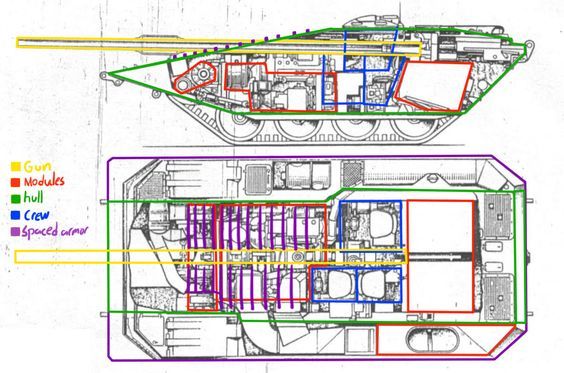
Il carro si presentava privo della torretta, di dimensioni molto contenute, armato un pezzo L74 da 105/62 mm, derivato dall'L7 britannico, montato fisso nello scafo, senza alcun tipo di brandeggio. Questo avveniva puntando tutto il carro e facendo ricorso a un sistema di sospensioni idropneumatico che consentiva all'armamento/scafo una elevazione di +12° e una depressione di -10°. Il carro non poteva sparare in movimento, e per il tiro le sospensioni venivano bloccate e sia il pilota che il capocarro potevano manovrarle per il puntamento. Il terzo membro dell'equipaggio era l'operatore radio, che poteva fungere anche da secondo pilota durante la marcia indietro. Il funzionamento del pezzo era completamente automatico, con clips di colpi che, una volta esaurite, venivano scaricate fuori dal mezzo. Anche i bossoli venivano espulsi automaticamente. La cadenza di tiro era pari a quindici colpi al minuto, con una dotazione standard di cinquanta colpi, situati nella parte posteriore dello scafo. Il munizionamento poteva comprendere 25 granate APDS, 20 granate HEAT e 5 fumogene. Una mitragliatrice KSP-58 da 7,62 mm era installata sulla cupola del capocarro, mentre ulteriori due mitragliatrici KSP-58 da 7,62 mm erano posizionate sul lato sinistro dello scafo. Il munizionamento disponibile per le mitragliatrici era pari a 2.750 colpi. Sulla parte superiore del carro eranpo posizionati due lanciatori Lyran per l'illuminazione notturna del bersaglio. Tutti i carri erano dotati di una lama apripista per scavare posizioni difensive.


Il propulsore policarburante a pistoni contrapposti Rolls-Royce K60, erogante la potenza di 243 CV (179 kW) a 3.750 giri/minuto, la turbina a gas Boeing 502 da 300 CV (223 kW) e la trasmissione erano posizionati nella parte anteriore dello scafo, e fungevano da ulteriore protezione per l'equipaggio. Il motore diesel viene utilizzato per la marcia ordinaria, la turbina a gas per gli spunti di potenza quando il mezzo era in movimento sul terreno vario. Un dispositivo di galleggiamento consentiva al mezzo di muoversi in acqua ad una velocità di 6 km/h, e il carro diveniva completamente anfibio con una preparazione di 25 minuti, con capacità di guadare un corso d'acqua profondo 1,5 m. La capacità carburante era pari a 960 litri. Il carro poteva superare una trincea larga 2,3 m, e un gradino alto 0,90 m.


Impiego operativo

Al suo apparire in servizio il Carro S, o Strv 103, suscitò subito un notevole interesse per la sua bassissima sagoma, propria dei cacciacarri che non degli MBT, un ottimo cannone, ma emersero anche delle limitazioni, in particolare in alcune circostanze, come nel caso di scontri in aree ristrette dovendo, per brandeggiare il cannone, muovere tutto il carro. Il modello Stridsvagn 103 fu realizzato in 300 esemplari tra il 1967 e il 1971, venendo progressivamente aggiornato, passando dalle versioni A e B al definitivo modello C. In particolare, lo Strv 103B fu equipaggiato con uno schermo impermeabile che consentiva di guadare i corsi d’acqua con una preparazione di 25 minuti. La versione Strv 103C vide la sostituzione del propulsore diesel Rolls-Royce K60 con un Detroit Diesel 6V da 290 hp, l'adozione di un cambio automatico e di un telemetro laser al posto del precedente sistema di stima della distanza. Il cannone da 105/62 mm, uno dei più potenti cannoni di questo calibro in servizio all’epoca, era caratterizzato da una elevata cadenza di tiro che consentiva di impegnare in successione numerosi bersagli, grazie al sistema di caricamento automatico.
Il programma di aggiornamento allo standard Stridsvagn 103D, avviato nei primi anni novanta del XX secolo venne abbandonato, in favore dell’adozione del più potente carro Stridsvagn 122 (Strv 122), dotato di cannone da 120 mm. Il modello Strv 103 fu ufficialmente ritirato dal servizio entro la fine del 1997, e nell’ultimo anno gli esemplari di Strv 103 furono usati per l’addestramento per gli equipaggi destinati ad operare sui carri armati. Il prototipo Strv 103D è oggi esposto al Museo di mezzi corazzati di Axvall, insieme ad alcuni carri 103C.


Versioni:
  • Stridsvagn 103A - prima versione di serie equipaggiata con propulsore Rolls-Royce K60 da 243 CV (179 kW), e turbina a gas Boeing 502 da 300 CV (179 kW),
  • Stridsvagn 103B - poiché il peso del carro armato Strv 103 era aumentato rispetto aqgli esemplari di preserie, il modello base 103 si rivelò sottopotenziato. Venne quindi introdotta, dopo la produzione dei primi 80 esemplari di serie, una versione più potente della stessa turbina a gas, prodotta dalla Caterpillar 553 da 497 CV (336 kW). I primi 80 carri (designati retroattivamente Strv 103A) furono subito portati allo standard B. Le nuove regolazioni della sospensione idro-pneumatica portarono l’elevazione massima da -10/+12 gradi, a -11/+16 gradi.
  • Stridsvagn 103C - nel 1986 fu avviato un programma di aggiornamento per dotare tutti i veicoli di un migliore sistema di controllo antincendio. Inoltre ogni Strv 103 fu equipaggiato con una lama apripista, ed inoltre, tra il 1987-1988 fu avviato un ulteriore programma di ammodernamento che prevedeva la sostituzione del motore Rolls-Royce K60 con un Diesel Detroit 6V-53T da 295 CV (216 kW), l’installazione di corazze reattive posizionate lungo i lati dello scafo e di un telemetro laser. Il peso massimo saliva a 42,5 tonnellate.
  • Stridsvagn 103D - verso la metà degli anni novanta del XX secolo le forze armate svedesi stavano considerando un nuovo aggiornamento per il carro Strv 103, che venne designato Strv 103D. Le principali modifiche riguardarono l'installazione di computer per il controllo del fuoco, di visori termici sia per l'artigliere che per il comandante, e di un intensificatore di luce passivi per il conducente. Inoltre furono apportate alcune modifiche minori al sistema di sospensione e al propulsore. Ne venne realizzato un prototipo che fu testato anche sotto controllo remoto.

Utilizzatori:
  • Svezia.


ENGLISH

The Stridsvagn 103 (Strv 103),  also known as the S-Tank, is a Swedish post-World War II main battle tank, designed and manufactured in Sweden. It was developed in the 1950s and was the first main battle tank to use a turbine engine and the only mass-produced tank since World War II to dispense with a turret. It has an unconventional design: it is turretless with a fixed gun traversed by engaging the tracks and elevated by adjusting the hull suspension. The result was a very low-profile design with an emphasis on survivability and heightened crew protection level. Strv 103s formed a major portion of the Swedish armoured forces from the 1960s to the 1990s, when, along with the Centurions, it was replaced by the Stridsvagn 121 and the Stridsvagn 122, variants of the Leopard 2. While turretless armoured fighting vehicles are usually classified as assault guns or tank destroyers, despite its unique gun laying process the Strv 103 is considered a tank since its designated combat role matched those of other tanks within contemporary Swedish doctrine.

History

In the mid-1950s, the Royal Swedish Army Materiel Administration (Kungliga Arméförvaltningens Tygavdelning) put out a contract tender for next generation tank design to replace their Centurions. A consortium of Landsverk, Volvo and Bofors responded with a suggestion to revive an earlier domestic heavy tank design, known under the codename KRV, fitted with a 155 mm smoothbore gun in an oscillating turret. However, this was deemed too expensive in comparison to the alternatives: A (Anglo-American), which was to purchase a 50-ton tank with high protection and mediocre mobility from either the UK or US. Alternative T (Tysk-Fransk /German-French) was a 30-ton tank with low protection and good mobility. Then, in 1956, Sven Berge of the Swedish Arms Administration proposed Alternativ S, a domestic alternative (S standing for Swedish).

Development

Studies of casualty reports from World War II and the Korean War revealed that the risk of being hit in combat was strongly related to height, with more than half of tank losses being the result of the turret being penetrated. Berge therefore concluded that any new design should be as low as possible. The radical solution was to eliminate the turret, which would also dispose of a vulnerable target area and make the tank much lighter. In terms of absolute height, the final design (see below) did not give the Strv 103 any significant advantage over its most likely opponent, the T-62. The latter was just sightly taller with 2.20 m (7 ft 3 in) in height with its turret versus the 2.14 m (7 ft 0 in) of the Strv 103. On the other hand, the Swedish Centurions towered over both with their 2.94 m (9 ft 8 in) – 3.01 m (9 ft 11 in) in height. However, the T-62 paid for its low profile with an extremely cramped interior and lack of gun depression. Tanks are often deployed in hull-down firing positions, either behind dug entrenchments or using the crest of a hill, in order to reduce the exposure of the vehicle to enemy fire. In this firing position, the level of exposure is determined by the distance between the bottom of the gun barrel to the top of the turret or vehicle, and the angle to which the vehicle is able to depress the gun barrel. Since the Strv 103 orients the entire tank to depress and elevate the barrel, in a hull down position it has very little apparent height and subsequent visual profile to the enemy. It could also lower the hull a further 13 centimetres (5.1 in) by adjusting the suspension.
Familiar with both the French Char B's precision transmission, the exceptional turning performance of the short tracked assault guns and the combat performance of the German StuG and Jagdpanzer series inspired Berge's design to solve the aiming problem through the use of a fully automated transmission and suspension system, which precisely turned and tilted the tank under the gunner's control. The gun itself would be fixed to the hull. This made it impossible to use a stabilised gun. As a result, the tank could not accurately move and fire at the same time, but the Swedish experience with Centurions suggested that, in order for tanks to reach acceptable accuracy, they would need to come to a halt anyway, and wrongly estimated that no breakthrough in stabilisation technology was likely within the foreseeable future.
Other features of the tank were also quite radical. The rifled gun, a Bofors 105 mm L74 with a barrel length of 62 calibres, was able to use the same ammunition as the British Royal Ordnance L7, and would be equipped with an autoloader allowing a rate of fire of one round every third second, also allowing the crew to be reduced to two; a gunner/driver and the commander (most designs of the era used a crew of four), with a single person being able to handle all functions of the tank from his ordinary position due to duplicate controls. This would of course only be used in emergencies, as the workload would be overwhelming, but apart from providing redundancy it also allowed the crew to shift tasks between them as situation required. The concept went through practical tests, that quickly revealed that a two-man crew would not be self-sufficient when considering the many tasks not directly related to handling the tank: in particular, routine maintenance, bivouacking, track-changes and reloading in field. While the last issue could have been solved by adding staff to the ammunition crews, it was decided that a third crew-member was needed. To enhance combat effectiveness, the third man was to be assigned as a rear driver/radio operator, facing the rear of the tank and equipped with a complete setup for driving. This allowed the tank to be driven backwards at the same speed as forwards, keeping its frontal armour pointed at the enemy, while relieving the commander of routine radio duty. The commander and gunner/driver both had the same set of sights and controls to fire the gun and drive the tank.
The tank was uniquely powered by two different kind of engines, a 240 horsepower (180 kW) Rolls-Royce K60 opposed-piston diesel for slow cruising and manoeuvring the tank in aiming, and a 300 horsepower (220 kW) Boeing 502 turbine for additional power when travelling at higher speed or in severe terrain; the same layout that later gave the naval configuration called CODAG (Combined Diesel And Gas), even if many ships had instead the simpler CODOG (COmbined Diesel Or Gas) thanks to the difference between the diesel and turbine power (see, as example, many frigate built for the NATO navies, like Maestrale and Bremen classes). The turbine was quickly found to be underpowered, and was replaced by a Caterpillar turbine delivering 490 horsepower (370 kW) after no more than 70 tanks had been produced, and retrofitted to all previous vehicles. This was the first use of a turbine engine in a production tank; the Soviet T-80 and US M1 Abrams would later be built with gas turbines for main propulsion. The concept was interesting enough that Bofors was asked to build a prototype of the suspension/drive train, which they completed successfully.
The Strv 103 was fully amphibious. A flotation screen could be erected around the upper hull in about 20 minutes, and the tracks would drive the tank at about 6 kilometres per hour (3.7 mph) in water.
One tank in each platoon was fitted with a dozer blade under the front hull, which was from outside the tank manually dropped and locked into working position with pins and support strutters. The blade allowed it to do simple engineering task, like digging fire pits for the platoon, filling trenches for ease of passage and so forth. Once the task was completed, the blade was again manually returned to the position under the front hull and locked in place. Upon the introduction of the 103C model all tanks had a bulldozer blade fitted, both to speed up operations and for the increased protection of the lower hull.

Service

In preparation for the defence plan of 1958 (Försvarsbeslut 1958 (FB58)) in the Riksdagen (Swedish parliament), the procurement set Alternativ S against the two foreign alternatives Alternativ A and Alternativ T. While the domestic alternative was going to be more expensive, the defence committee report recommended "S" when weighing in the symbolic value of a domestic tank for a neutral country as well as the spin-off effects on Swedish industrial competence.
Riksdagen made the formal decision regarding FB58 on 4 February 1958, and a follow-on contract called for two production prototypes, which were completed in 1961. By this point, the army was so satisfied with the design that an initial pre-production order for 10 was placed in 1960.
With minor changes, the Alternativ S was adopted as the Stridsvagn 103 ("103" from being the third tank with a 10 cm calibre gun accepted into Swedish service). Full production started in 1967 and ended in 1971 with 290 delivered. The changes included a new gyro-stabilised commander's cupola armed with a 7.62mm KSP 58 machine gun, and upgraded frontal armour. A unique grid could be mounted at the front to help defeat HEAT rounds; however, it was kept secret for many years and was to be fitted only in the event of war.
Despite its design the Strv 103 was intended for offensive operations. The armoured brigades of the Swedish army, which operated the Strv 103, were designated anfallsbrigader (assault brigades) and tasked with launching counter-offensives on enemy beachheads and airborne landings. The stated Swedish armoured doctrine contemporary to the tank describes an aggressive approach to armoured warfare, even in defensive situations. The design of the Strv 103, with its low profile, was based on protection rather than defensive battlefield behaviour.
In 1980, the Swedish army requested all tanks in the inventory to be scrapped and replaced with Stridsvagn 2000. In 1982, the Riksdag decided for severe reduction of the military budget in Försvarsbeslutet 1982, and decided the tank-fleet should go through a REMO (Renovation and modification) to at least somewhat bring them up to standard while within the economic frames imposed.

Performance

The Stridsvagn 103 never saw combat and so its design remains unproven. However, for its intended role in the 1960s, it had numerous advantages. In 1967, Norway carried out a two-week comparative observation test with the Leopard 1 and found that, with closed hatches, the 103 spotted more targets and fired faster than the Leopard while the situation was reversed when operating with hatches open. In April to September 1968, two 103s were tested at the British armour school in Bovington, which reported that "the turretless concept of the "S"-tank holds considerable advantage over turreted tanks". In 1973, the BAOR tested the 103. British crewmen received six weeks training and the vehicles were serviced by Swedish engineers. Over nine days of manoeuvres alongside the Chieftain tank, availability never fell under 90% and the final report stated, "It has not been possible to prove any disadvantage in the "S" inability to fire on the move." In 1975, two 103s were tested at the American armour center at Fort Knox. The trial demonstrated that the 103 fired more accurately than the M60A1E3, but on an average 0.5 seconds more slowly.
In comparison with the Centurion, the shorter track of strv 103 meant it performed worse on soft ground (mud and snow), the trench taking and vertical obstacle capabilities were also significantly lower: where the Centurion climbed a 100 cm wall, the 103 barely was able to climb an 80 cm wall. On hard terrain, the 103 on the other hand was far more manoeuvrable.

Versions:
  • Stridsvagn 103B - As the weight of the Strv 103 had increased compared to the pre-production tanks, the 103 turned out to be under-powered. Hence, a more powerful version of the same gas turbine, manufactured by Caterpillar, was introduced after the first production run of 80 tanks. The early version tanks (retroactively designated Strv 103A) were soon upgraded to B-standard. Adjustments to the hydro-pneumatic suspension increased elevation range from −10 through +12 degrees, to −11 through +16 degrees.
  • Stridsvagn 103C - An upgrade programme was started in 1986 to fit all vehicles with improved fire control systems. Also, each Strv 103 was fitted with a dozer blade, rather than just one per platoon. A further upgrade in 1987/88 replaced the Rolls-Royce engine with a newer 290 horsepower (220 kW) Detroit Diesel with additional fuel cans placed along the sides to function as applique armour, and added a new laser rangefinder.
  • Stridsvagn 103D - In the mid-1990s, as the Swedish Armed Forces were looking for a new main battle tank, one Strv 103C was upgraded into the Strv 103D. The major changes were the installation of fire-control computer, thermal viewers for both the gunner and the commander, allowing the crew to fight at night-time and in bad weather conditions, and the installation of passive light enhancers for driving. Some minor changes to the suspension system and engine were also made.
There was some consideration of adding both reactive and/or appliqué armour in the early 1990s, but, in the end, the Strv 103 was instead phased out of Swedish service in favour of the Stridsvagn 122 (Strv 122), which entered service in 1997 (the last year that the Strv 103 was used to train tank crews).
This prototype was used during the trials for the new main battle tank system for the Swedish Armed Forces alongside all the other tanks tested. For a few years this prototype was even tested under remote control. The sole Strv 103D is today on display at the Axvall armor museum, together with some 103C models. They are all still in running order.

Tanks on display

The following exhibitions possess an S-tank on display:
  • Sweden - Försvarsmuseum Boden, Boden through Föreningen P5 - Försvarsfordonsmuseet Arsenalen, Härad, Sweden.
  • Germany - Deutsches Panzermuseum Munster.
(Web, Google, Wikipedia, You Tube)




mercoledì 18 marzo 2020

Il THAAD: Terminal High Altitude Area Defense (Difesa d'area terminale ad alta quota)


Terminal High Altitude Area Defense (in sigla: THAAD, in italiano: Difesa d'area terminale ad alta quota), ex Theater High Altitude Area Defense, è un sistema antimissile dell'esercito statunitense per colpire missili balistici a medio e corto raggio.
Il THAAD è stato sviluppato dopo l'esperienza degli attacchi missilistici Scud in Iraq durante la Guerra del Golfo nel 1991. L'intercettore THAAD non trasporta una testata, ma si affida alla sua energia cinetica di impatto per distruggere il missile in arrivo. Un colpo di energia cinetica riduce al minimo il rischio di esplodere missili balistici a testata convenzionale e la testata di missili balistici a punta nucleare non farà esplodere un colpo di energia cinetica.


Terminal High Altitude Area Defense (THAAD):
  • Sistema missilistico anti-balistico mobile
  • Luogo d’origine USA
  • In servizio 2008-presente
  • Usato da Esercito degli Stati Uniti
  • Progettato nel 1987
  • fabbricante Lockheed Martin
  • prodotto dal 2008 ad oggi
  • Massa 900 kg
  • Lunghezza 6,17 m
  • Diametro 34 cm.
  • Motore Razzo monostadio
  • Propellente a Razzo a combustibile solido di Pratt & Whitney
  • Raggio d’azione > 200 km
  • Altitudine di volo 93 miglia (150 km)
  • Velocità Mach 8.24 (2.8 km / s)
  • sistema di guida Testa del cercatore di infrarossi di imaging con indio-antimonide
  • Precisione 0m
  • Veicolo Trasportatore: TEL.


Originariamente il programma dell’Us Army THAAD è entrato sotto l'egida della Missile Defence Agency. La Us Navy ha un programma simile imbarcato, il Aegis Balistic Missile Defense System, che ha anche una componente terrestre. Il sistema THAAD era originariamente previsto per lo spiegamento nel 2012, ma lo schieramento iniziale è avvenuto solo nel maggio 2008. Il THAAD è stato dispiegato a Guam, negli Emirati Arabi Uniti, in Israele, in Romania e nella Corea del Sud.
Le analisi di vulnerabilità e letalità del THAAD sono state condotte dal US Army Research Laboratory (ARL). La valutazione della vulnerabilità per THAAD ha caratterizzato una valutazione degli effetti dei principali elementi elettromagnetici. Ciò includeva interferenze EM, operazioni di radiazione EM, rischi di radiazione EM, impulso EM, scarica elettrostatica ed effetti di fulmini sui componenti del sistema THAAD. 
Le valutazioni ARL sono state progettate per determinare il potenziale di crescita del sistema THAAD dato il suo design tattico e fornire analisi di sopravvivenza contro minacce come armi convenzionali, armi chimiche e contromisure di guerra elettronica. I dati raccolti dalle analisi sono stati utilizzati per sviluppare modelli di traiettoria per bersagli e missili, nonché traiettorie di bersagli utilizzando la generazione di scene a infrarossi di contromisure a infrarossi (IRCM). 
Il sistema THAAD è stato progettato, costruito e integrato da Lockheed Martin Missiles e Fire Control in qualità di prime contractor. I principali subappaltatori includono Raytheon, Boeing, Aerojet Rocketdyne, Honeywell, BAE Systems, Oshkosh Defence e MiltonCAT. 


SVILUPPO

Il concetto di difesa antimissile THAAD è stato proposto nel 1987, con una richiesta formale presentata all'industria nel 1991. Il programma THAAD ha beneficiato dei risultati di precedenti sforzi di difesa antimissile come HEP e il Kinetic Kill Vehicle Integrated Technology Experiment. Nel settembre 1992, l'esercito americano scelse Lockheed (ora Lockheed Martin) come appaltatore principale per lo sviluppo del sistema THAAD. Prima dello sviluppo di un prototipo fisico, fu sviluppato il codice software Aero-Optical Effect (AOE) per convalidare il profilo operativo previsto del progetto proposto da Lockheed. Il primo test di volo THAAD si è svolto nell'aprile 1995, con tutti i test di volo nella fase di dimostrazione di validazione dimostrativa (DEM-VAL) che si sono verificati presso la White Sands Missile Range. I primi sei tentativi di intercettazione non hanno raggiunto l'obiettivo (Voli 4–9). Le prime intercettazioni riuscite furono condotte il 10 giugno 1999 e il 2 agosto 1999, contro i missili Hera.


Funzionamento

Il missile non trasporta nessuna testata ma si basa sull'energia cinetica dell'impatto. Il THAAD fu progettato per colpire missili Scud e similari, ma ha una capacità limitata contro gli ICBM come fu dimostrato il 24 ottobre 2012. Il sistema THAAD è stato progettato, costruito ed integrato da Lockheed Martin Space Systems. Subappalti sono stati assegnati a Raytheon, Boeing, Aerojet, Rocketdyne, Honeywell, BAE Systems, MiltonCAT, e Oliver Capital Consortium. Un singolo sistema THAAD costa 800 milioni di dollari statunitensi.
Il suo primo dispiegamento è cominciato a maggio 2008, nonostante fosse pensato per il 2012.


Utilizzatori
  • Arabia Saudita - Reale forza terrestre saudita - 11 batterie (comprensive di 44 lanciatori, 360 missili intercettori, 16 sistemi per il controllo del fuoco e stazioni mobili per le comunicazioni e 7 radar AN/TPY-2) per circa 15 miliardi dollari complessivi, ordinate a marzo 2019 e con consegne a partire dalla metà dello stesso anno ed il 2026.
  • Stati Uniti - US Army.


IL SEEKER DI BAE SYSTEMS

La Lockheed Martin, che costruisce il sistema d'armamento per la difesa dell'area ad alta quota per l’Us Army, ha assegnato alla britannica BAE Systems un contratto per la progettazione e la produzione di un “SEEKER” (cercatore) di nuova generazione per gli intercettatori del sistema, secondo un annuncio della BAE pubblicato il 17 marzo 2020.
Il lavoro di progettazione dei sensori migliorerà la capacità del sistema di difesa missilistica di neutralizzare più minacce e migliorarne la costruzione in serie. La società non ha rivelato l'importo del contratto o le tempistiche per sviluppare un progetto.
Il sistema d'arma THAAD fa parte dell'approccio a più livelli dell’US ARMY alla difesa missilistica, ora con la sua capacità di annientare le minacce di missili balistici nella fase terminale del volo; l'Agenzia per la difesa missilistica vuole anche rendere il sistema parte della sua futura architettura di difesa della patria.
BAE fornisce già il “seeker” per il sistema THAAD, che utilizza immagini a infrarossi per guidare gli intercettatori verso i bersagli delle minacce, e l'azienda ha consegnato ad oggi più di 500 cercatori THAAD.
Mentre i “seeker” sono costruiti a Nashua, New Hampshire, e Endicott, New York, l'azienda ha in programma di condurre il lavoro di progettazione per il cercatore di nuova generazione a Huntsville, Alabama, sede dell'Arsenale di Redstone e dei programmi missilistici e spaziali dell’esercito. L’azienda sta costruendo una struttura all'avanguardia che ospiterà un programma di progettazione "all'avanguardia" ad Huntsville.
Mentre l'Esercito prevede di continuare a utilizzare la THAAD anche in futuro, l'MDA ha in programma di stanziare, nel 2021, 273,6 milioni di dollari per gli sforzi di sviluppo del THAAD, compreso il livello di difesa della patria con il THAAD. In particolare, l'agenzia chiede 139 milioni di dollari per l'anno fiscale 2021 per iniziare lo sviluppo e la dimostrazione di un nuovo prototipo di intercettore per la THAAD, che potrebbe sostenere un approccio graduale e stratificato alla difesa della patria. BAE Systems non ha confermato se il lavoro di progettazione dell'intercettore di prossima generazione includa sforzi legati al desiderio dell’MDA di produrre un nuovo prototipo di intercettore.
L'agenzia sta sfidando Bae Systems a capire come sviluppare un intercettore THAAD che funzioni contro un missile balistico intercontinentale. L’MDA sta inoltre cercando di trarre lezioni dalla costruzione di batterie missilistiche THAAD per l'Arabia Saudita.
L'agenzia sta anche esaminando lo spazio commerciale ingegneristico esistente.
Si potrà prendere in considerazione una pila di propulsione potenziata per dare al THAAD un raggio d'azione più esteso aggiornando la propulsione.
Il programma di intercettazione THAAD avrà un nuovo inizio nella richiesta di budget dell'anno fiscale FY21.


ENGLISH

Terminal High Altitude Area Defense (THAAD), formerly Theater High Altitude Area Defense, is an American anti-ballistic missile defense system designed to shoot down short-, medium-, and intermediate-range ballistic missiles in their terminal phase (descent or reentry) by intercepting with a hit-to-kill approach. THAAD was developed after the experience of Iraq's Scud missile attacks during the Gulf War in 1991. The THAAD interceptor carries no warhead, but relies on its kinetic energy of impact to destroy the incoming missile. A kinetic energy hit minimizes the risk of exploding conventional-warhead ballistic missiles, and the warhead of nuclear-tipped ballistic missiles will not detonate upon a kinetic-energy hit.
Originally a United States Army program, THAAD has come under the umbrella of the Missile Defense Agency. The Navy has a similar program, the sea-based Aegis Ballistic Missile Defense System, which also has a land component ("Aegis ashore"). THAAD was originally scheduled for deployment in 2012, but initial deployment took place in May 2008. THAAD has been deployed in Guam, the United Arab Emirates, Israel, Romania, and South Korea.
The vulnerability and lethality analyses of the THAAD have been conducted by the U.S. Army Research Laboratory (ARL). The vulnerability assessment for the THAAD featured an evaluation of the effects of major electromagnetic elements. This included EM interference, EM radiation operations, EM radiation hazards, EM pulse, electrostatic discharge, and lightning effects on components of the THAAD system.
The ARL assessments were designed to determine the THAAD system's growth potential given its tactical design as well as provide survivability analysis against threats such as conventional weapons, chemical weapons, and electronic warfare countermeasures. The data collected from the analyses were used to develop trajectory models for targets and missile as well as target trajectories using infrared scene generation of infrared countermeasures (IRCMs).
The THAAD system is being designed, built, and integrated by Lockheed Martin Missiles and Fire Control acting as prime contractor. Key subcontractors include Raytheon, Boeing, Aerojet Rocketdyne, Honeywell, BAE Systems, Oshkosh Defense, and MiltonCAT.


Development

The THAAD missile defense concept was proposed in 1987, with a formal request for proposals submitted to industry in 1991. The THAAD program benefited from results of previous missile defense efforts like High Endoatmospheric Defense Interceptor (HEDI) and the Kinetic Kill Vehicle Integrated Technology Experiment (KITE). In September 1992, the US Army selected Lockheed (now Lockheed Martin) as prime contractor for THAAD development. Prior to development of a physical prototype, the Aero-Optical Effect (AOE) software code was developed to validate the intended operational profile of Lockheed's proposed design. The first THAAD flight test occurred in April 1995, with all flight tests in the demonstration-validation (DEM-VAL) program phase occurring at White Sands Missile Range. The first six intercept attempts missed the target (Flights 4–9). The first successful intercepts were conducted on 10 June 1999 and 2 August 1999, against Hera missiles.


Engineering and manufacturing

In June 2000, Lockheed won the Engineering and Manufacturing Development (EMD) contract to turn the design into a mobile tactical army fire unit. Flight tests of this system resumed with missile characterization and full system tests in 2006 at White Sands Missile Range, then moved to the Pacific Missile Range Facility. The Interceptor was led through development and initial production by Tory Bruno, who later became CEO of United Launch Alliance.

THAAD-ER

Lockheed is pushing for funding for the development of an extended-range (ER) version of the THAAD to counter maturing threats posed by hypersonic glide vehicles that adversaries may deploy, namely the Chinese WU-14, to penetrate the gap between low- and high-altitude missile defenses. The company performed static fire trials of a modified THAAD booster in 2006 and continued to fund the project until 2008. The current 14.5 in (37 cm)-diameter single-stage booster design would be expanded to a 21 in (53 cm) first stage for greater range with a second "kick stage" to close the distance to the target and provide improved velocity at burnout and more lateral movement during an engagement. Although the kill vehicle would not need redesign, the ground-based launcher would have only five missiles instead of eight. As of early 2015, THAAD-ER is only an industry concept, but Lockheed believes that the Missile Defense Agency will show interest because of the weapons under development by potential adversaries. If funding for the THAAD-ER begins in 2018, a system could be produced by 2022 to provide an interim capability against a rudimentary hypersonic threat. The Pentagon is researching whether other technologies like directed energy weapons and railguns are better solutions for missile defense; these are expected to become available in the mid to late 2020s.

Production

Sometimes called Kinetic Kill technology, the THAAD missile destroys missiles by colliding with them, using hit-to-kill technology, like the MIM-104 Patriot PAC-3 (although the PAC-3 also contains a small explosive warhead). This is unlike the Patriot PAC-2 which carried only an explosive warhead detonated using a proximity fuze. Although the actual figures are classified, THAAD missiles have an estimated range of 125 miles (200 km), and can reach an altitude of 93 miles (150 km). A THAAD battery consists of at least six launcher vehicles, each equipped with eight missiles, with two mobile tactical operations centers (TOCs) and the AN/TPY-2 ground-based radar (GBR); the U.S. Army plans to field at least six THAAD batteries, at a purchase cost of US$800 million per battery. By September 2018 MDA plans to deliver 52 more interceptors to the Army.
The THAAD missile is manufactured at a Lockheed Martin facility near Troy, Alabama. The facility performs final integration, assembly and testing of the THAAD missile. The THAAD Radar is an X-Band active electronically scanned array Radar developed and built by Raytheon at its Andover, Massachusetts Integrated Air Defense Facility. The THAAD radar and a variant developed as a forward sensor for ICBM missile defense, the Forward-Based X-Band – Transportable (FBX-T) radar, were assigned a common designator, AN/TPY-2, in late 2006/early 2007. The THAAD radar can interoperate with Aegis and Patriot systems, in a 3-layer antimissile defense.

First units equipped (FUE)

On 28 May 2008, the U.S. Army activated Alpha Battery, 4th Air Defense Artillery Regiment (A-4), 11th Air Defense Artillery Brigade at Fort Bliss, Texas. Battery A-4 is part of the 32nd Army Air & Missile Defense Command. At the time, the battery had 24 THAAD interceptors, three THAAD launchers based on the M1120 HEMTT Load Handling System, a THAAD Fire Control and a THAAD radar. Full fielding began in 2009. On 16 October 2009, the U.S. Army and the Missile Defense Agency activated the second Terminal High Altitude Area Defense Battery, Alpha Battery, 2nd Air Defense Artillery Regiment (A-2), at Fort Bliss.
On 15 August 2012, Lockheed received a $150 million contract from the Missile Defense Agency (MDA) to produce THAAD Weapon System launchers and fire control and communications equipment for the U.S. Army. The contract included 12 launchers, two fire control and communications units, and support equipment. The contract provided six launchers for THAAD Battery 5 and an additional three launchers each to Batteries 1 and 2. These deliveries will bring all batteries to the standard six launcher configuration.

General missile defense plans

In May 2017, the Pentagon proposed spending $7.9 billion in its FY 2018 budget on missile defense which includes THAAD interceptors and Patriot interceptors, along with $1.5 billion for Ground-based Midcourse Defense (GMD) against intercontinental ballistic missiles.

Deployments

Hawaii

In June 2009, the United States deployed a THAAD unit to Hawaii, along with the SBX sea-based radar, to defend against a possible North Korean launch targeting the archipelago.

Guam

In April 2013, the United States declared that Alpha Battery, 4th Air Defense Artillery Regiment (A-4), would be deployed to Guam to defend against a possible North Korean IRBM attack targeting the island. In March 2014, Alpha Battery, 2nd ADA RGT (A-2), did a change of responsibility with A-4 and took over the Defense of Guam Mission. After a successful 12-month deployment by A-4, Delta 2 (D-2) took its place for a 12-month deployment. In 2018-2019 Echo Battery, 3rd ADA Regiment (E-3) deployed to Guam.

UAE

The United Arab Emirates signed a deal to purchase the missile defense system on 25 December 2011. The United Arab Emirates (UAE) has graduated its first two THAAD unit classes at Fort Bliss in 2015 and 2016. Its first live-fire exercises with Patriot missiles took place in 2014.

Israel

In March 2019, Bravo Battery, 2nd ADA Regiment (B-2 THAAD), 11th Air Defense Artillery Brigade was deployed at Nevatim Airbase during a joint US-Israeli drill, after which it was to be moved to an undisclosed location in the Negev desert in southern Israel. The X-Band radar system, which is part of the THAAD system, has been deployed at Nevatim since 2008.
In 2012, the U.S. AN/TPY-2 early missile warning radar station on Mt. Keren in the Negev desert was the only active foreign military installation in Israel.

Turkey

According to U.S. officials the AN/TPY-2 radar was deployed at Turkey's Kürecik Air Force base. The radar was activated in January 2012.

Romania

In 2019, while the Aegis Ashore at NSF Deveselu is being upgraded, B Battery, 62nd Air Defense Artillery Regiment (B-62 THAAD), has emplaced in NSF Deveselu, Romania during the interim.

Wake Island

On 1 November 2015, a THAAD system was a key component of Campaign Fierce Sentry Flight Test Operational-02 Event 2 (FTO-02 E2), a complex $230 million missile defense system test event conducted at Wake Island and the surrounding ocean areas. The objective was to test the ability of the Aegis Ballistic Missile Defense and THAAD Weapon Systems to defeat a raid of three near-simultaneous air and missile targets, consisting of one medium-range ballistic missile, one short-range ballistic missile and one cruise missile target. During the test, a THAAD system on Wake Island detected and destroyed a short-range target simulating a short-range ballistic missile that was launched by parachute ejected from a C-17 transport plane. At the same time, the THAAD system and the USS John Paul Jones guided missile destroyer both launched missiles to intercept a medium-range ballistic missile, launched by parachute from a second C-17.

South Korea

On 17 October 2013, the South Korean military asked the Pentagon to provide information on the THAAD system concerning prices and capabilities as part of efforts to strengthen defenses against North Korean ballistic missiles. However, South Korean Park Geun-hye administration decided it will develop its own indigenous long-range surface-to-air missile instead of buying the THAAD. South Korean Defense Ministry officials previously requested information on the THAAD, as well as other missile interceptors like the Israeli Arrow 3, with the intention of researching systems for domestic technology development rather than for purchase. Officials did however state that American deployment of the THAAD system would help in countering North Korean missile threats. Later South Korea announced it would be deploying THAAD by the end of 2017. In May 2014, the Pentagon revealed it was studying sites to base THAAD batteries in South Korea.
In February 2016, Chinese Foreign Minister Wang Yi expressed concerns that deployment of THAAD in South Korea, despite being directed at North Korea, could jeopardize China's "legitimate national security interests" and in 2017 the Vice Chairman of China's Central Military Commission asserted to the Chairman of the US Joint Chiefs of Staff that deployment of THAAD around China was one of the factors which had a negative influence on "bilateral military ties and mutual trust." The major controversy among Chinese officials is that they believe the purpose of the THAAD system, "which detects and intercepts incoming missiles at high altitudes, is actually to track missiles launched from China" not from North Korea. Chinese experts report that China is focused on the positioning of another THAAD radar system, this one on the Korean peninsula, for gleaning details about China's nuclear weapons delivery systems, such as THAAD's ability to distinguish which missiles might be carrying decoy warheads. Bruce W. Bennett pointed out that China has deployed an S-400 missile system to the Shandong peninsula, between Pyongyang and Beijing, which appears to be a defense against North Korean missiles.
In July 2016, American and South Korean military officials agreed to deploy the THAAD missile defense system in the country to counter North Korea's growing threats and use of ballistic missile and nuclear tests; each THAAD unit consists of six truck-mounted launchers, 48 interceptors, a fire control and communications unit, and an AN/TPY-2 radar. Seongju County in North Gyeongsang Province was chosen as a THAAD site, partly because it is out of range of North Korean rocket artillery along the DMZ. This sparked protests from Seongju County residents, who feared that radiation emitted by the AN/TPY-2 radar would impact their health, and damage the region's famed oriental melon crop. On 30 September 2016, the U.S. and South Korea announced that THAAD would be relocated to Lotte Skyhill Seongju Country Club, farther from the town's main residential areas and higher in elevation, to alleviate concerns.
On 6 March 2017, two THAAD launcher trucks arrived by air transport at Osan Air Base South Korea, for a deployment. Earlier that day, North Korea had launched 4 missiles. A Reuters article stated that with the THAAD defense system, a North Korean missile barrage would still pose a threat to South Korea, while an article in the International Journal of Space Politics & Policy said that South Korean forces already possess Patriot systems for point defense and Aegis destroyers capable of stopping ballistic missiles that may come from the north, in a three-layer antimissile defense for South Korea. On 16 March 2017, a THAAD radar arrived in South Korea. The THAAD system is kept at Osan Air Base until the site where the system is due to be deployed is prepared, with an expected ready date of June 2017. Osan Air Base has blast-hardened command posts with 3 levels of blast doors.
By 25 April 2017, six trailers carrying the THAAD radar, interceptor launchers, communications, and support equipment entered the Seongju site. On 30 April 2017, it was reported that South Korea would bear the cost of the land and facilities for THAAD, while the US will pay for operating it. On 2 May 2017, Moon Sang-gyun, with the South Korean Defense Ministry and Col. Robert Manning III, a spokesman for the U.S. military announced that the THAAD system in Seongju is operational and "has the ability to intercept North Korean missiles and defend South Korea." It was reported that the system will not reach its full operational potential until later this year when additional elements of the system are onsite. On 7 June 2017 President Moon Jae-in suspended further THAAD deployment pending a review, after discovering four addition launchers had entered South Korea without the defense ministry informing him. The 35th Air Defense Artillery Brigade (United States) has integrated THAAD into its layered defense on the Korean Peninsula, denoted Combined Task Force Defender, composed of both US and ROK personnel.
Even in the face of a North Korean ICBM test on 4 July 2017, which newly threatens Alaska, a Kodiak, Alaska-based THAAD interceptor test (FTT-18) against a simulated attack by an Intermediate Range Ballistic Missile had long been planned. FTT-18 was successfully completed by Battery A-2 THAAD (Battery A, 2nd Air Defense Artillery Regiment, Terminal High Altitude Area Defense) of the 11th Air Defense Artillery Brigade (United States) on 11 July 2017. The soldiers used the procedures of an actual combat scenario and were not aware of the IRBM's launch time.
Also in 2017 another Kodiak launch of a THAAD interceptor was scheduled between 7:30PM and 1:30AM on Saturday 29 July, Sunday 30 July, or Monday 31 July, at alternative times, in preparation for a possible ICBM test by North Korea. On 28 July 2017 North Korea launched a test ICBM capable of reaching Los Angeles. In response, President Moon Jae-in called for deployment of the four remaining THAAD launchers which were put on hold when he came to power. Lee Jong-kul, of South Korean President Moon Jae-in's Democratic Party of Korea states "The nuclear and missile capabilities of North Korea…have been upgraded to pose serious threats; the international cooperation system to keep the North in check has been nullified...", citing tensions over the U.S. deployment of the Terminal High Altitude Area Defense anti-missile system in South Korea. The Atlantic Council, in the June 2017 memorandum "Eliminating the Growing Threat Posed by North Korean Nuclear Weapons" to President Trump, recommends a checklist of actions, including the following declarations to North Korea.
No use of WMDs, or it will result in a unified Korea under Seoul after the North's assured destruction.
No export of nuclear equipment or fissile material; it will be intercepted, and the US will respond.
No missile or missile test aimed at ROK (South Korea), Japan, or the US; it can then be shot down or pre-empted.

On 30 July 2017, a Kodiak-sited THAAD interceptor shot down an MRBM which launched over the Pacific Ocean, the 15th successful test; the Missile Defense Agency (MDA) director emphasized the data collection from the intercept, which enhances the modelling and scenario simulation capabilities of the MDA. John Schilling estimates the current accuracy of the North's Hwasong-14 as poor at the mooted ranges which threaten US cities (which would require more testing to prove its accuracy).
On 11 August 2017, The New York Times reviewed the anti-missile options that are available to counter a planned salvo of four Hwasong-12 missiles, were they to be launched in mid-August 2017 from the North, and aimed to land just outside the territorial waters of Guam, a distance of 2100 miles, flying at altitudes exceeding 62 miles, in a flight of 1065 seconds. These options for the missile defense of South Korea include "sea-based, Patriots and THAAD" according to General John E. Hyten, commander of U.S. Strategic Command.
On 2 September 2017, the North Korean news agency KCNA released a photograph of an elongated payload, intended to fit in the warhead of one of its missiles. On 3 September 2017 both Japan's Foreign Ministry and the South Korean Joint Chiefs announced the detection of a magnitude 6.3 seismic event, centered near Punggye-ri, which is North Korea's underground nuclear test site. Japan's Foreign Ministry has concluded that the event was the North's sixth nuclear test. Choe Sang-hun of the New York Times reports that the test was a major embarrassment for China's president Xi Jinping, who was hosting a BRICS summit (Brazil, Russia, India, China, and South Africa) in Xiamen, China. Cheng Xiaohe, an expert on North Korea at China's Renmin University, said the timing of the test appears to be deliberate. China's Foreign Ministry urged the North to "stop taking wrong actions", and agreed that further UN actions are needed to resolve the impending crisis. By creating a thermonuclear-capable payload for at least one of its missiles, the North has created a need for THAAD, which is capable of intercepting ICBM threats at the lower altitudes and ranges estimated for a Hwasong-14 ICBM subjected to the load of a heavier warhead needed to carry a thermonuclear weapon.
On 4 September 2017, BBC analyst Jonathan Marcus predicted a flood of several million refugees at the border of North Korea and China, were the North to be destroyed. China has positioned only two brigades at the border. Marcus points out that China and Russia have proposed the de-nuclearization of Korea and the replacement of the armistice with a peace treaty.
On 25 October 2017, Battery D, 2nd Air Defense Artillery Regiment, Terminal High Altitude Area Defense, reflagged with the 35th Air Defense Artillery Brigade in preparation for a permanent change of station to South Korea. In the interim before THAAD D-2's permanent transfer to South Korea with their families, THAAD Battery A-4 will deploy to South Korea.
On 30 October 2017, South Korea and China agreed to normalize relations, which had rifted due to THAAD deployment.

Controversy

Several communities outside of the U.S. have opposed the rollout of THAAD-type systems mostly about the pricing of the systems, such as Poland. Some critics have indicated that the rollout of THAAD along the former Iron Curtain and around China is not consistent with the stated goals of the rollout. In Korea there have been public protests against the THAAD system and the seeming need for the system in their territory.

2017 Korean deployment decision

Korean decision to deploy THAAD to protect itself against North Korea have caused backlash and retaliation measures from China.

Future deployments: firm orders and possible plans

Europe and the Middle East

By March 2016, Army Space and Missile Defense Command was considering THAAD deployments to Europe with EUCOM and the Middle East with CENTCOM.

Oman

On 27 May 2013, Oman announced a deal for the acquisition of the THAAD air defense system. However, a sale has not been announced.

Saudi Arabia

On 6 October 2017, the US has reached a deal to provide Saudi Arabia with THAAD in a deal worth $15 billion. Seven fire units each with a Raytheon AN/TPY-2 radar, two mobile tactical stations (with two spares for a total of 16), and six launchers (with two spares for a total of 44), 360 interceptor missiles.

Japan

In November 2015, Japanese Defense Minister Gen Nakatani said he would consider the U.S. deploying the THAAD in Japan to counter the threat of North Korean ballistic missiles. By October 2016, Japan was considering procuring either THAAD or Aegis Ashore to add a new missile defense layer. In May 2017 it was reported that Japan government officials now favor the Aegis Ashore system as it comes with a wider coverage area, which would mean fewer units needed to protect Japan, and it is also cheaper.
At the Center for a New American Security 2017 conference, citing publicly available sources and simulations of strikes against US bases in Asia, two Navy Fellows, Commanders Shugart and Gonzalez, USN noted that two more Patriot batteries, two more Aegis ships, and five more THAAD batteries would counter China's published SRBM (short-range) and MRBM (medium-range) capabilities against Japan.
Russia fears that the US will have access to the management of Aegis Ashore missile defense complexes after their deployment in Japan. Russia has data that missile defense systems will have shock capabilities. "We do not know of any cases anywhere in the world when the United States deployed its weapons and transferred control over them to the country in whose territory it all happened." I very much doubt that they will make an exception and in this case, "- concluded the Russian Foreign Minister.

Taiwan

A Hong Kong–based media report has claimed that THAAD could be deployed in Taiwan to intercept People's Republic of China missiles. However, Taiwan's Foreign Minister, David Lee, has said he is unaware of any talks with the US about possible deployment. Local military experts have said that it was neither necessary, nor affordable for Taiwan to deploy THAAD because China is threatening Taiwan with short-range missiles, whereas THAAD is designed to shoot down medium and long-range missiles. The Minister of National Defense, Feng Shih-kuan, said in March 2017 that he was firmly opposed to the deployment of a THAAD system in Taiwan although comments made by Feng's deputy minister Cheng De-mei during a Foreign Affairs and National Defense Committee Q&A session that was held in April 2017 in which he said that Taiwan did not need a THAAD system in the short term because its US-made phased-array radar system at Hsinchu County’s Leshan base was on par with the THAAD system in terms of detection capability was described as "in slight contrast with Minister of National Defense Feng Shih-kuan’s last month.” It was reported that Freddy Lim urged the ministry during the same Q&A session "to procure whatever is necessary to ensure the nation’s defense capabilities, which could not be compromised due to China’s pressure."
Taiwan's tracking data from its early warning system, built by the manufacturer of the THAAD radar, can serve to counter China's missile launches.
In response, a retired Chinese general Wang Hongguang warned that if Taiwan were to start deploying THAAD systems then the People's Liberation Army would start the process to conquer Taiwan.

BAE SYSTEMS SEEKER

Lockheed Martin, which builds the Terminal High Altitude Area Defense weapon system for the U.S. Army, has awarded BAE Systems a contract to design and manufacture a next-generation seeker for the system’s interceptors, according to a BAE announcement posted March 17.
“The sensor design work will improve the missile defense system’s ability to neutralize more threats and improve its manufacturability,” the statement read. The company did not disclose the contract amount or timelines to develop a design.
The THAAD weapon system is part of the Army’s layered approach to missile defense, now with its ability to defeat ballistic missile threats in the terminal phase of flight, but the Missile Defense Agency also wants to make it part of its future homeland defense architecture.
BAE already provides the seeker for the THAAD system, which uses infrared imagery to guide the interceptors to threat targets, and the company has delivered more than 500 THAAD seekers to date, according to the statement.
While the seekers are built in Nashua, New Hampshire, and Endicott, New York, the company plans to conduct design work for the next-generation seeker in Huntsville, Alabama, home of Redstone Arsenal and the Army’s missiles and space programs.
BAE Systems is building a state-of-the-art facility that will house a “cutting-edge” design program in Huntsville, the company noted.
While the Army plans to continue using THAAD far into the future, the MDA is, in fiscal 2021, planning to allocated $273.6 million for THAAD development efforts, including the THAAD homeland defense tier.
Specifically, the agency is asking for $139 million in FY21 to start the development and demonstration of a new interceptor prototype for THAAD, which could support a tiered and layered approach to homeland defense.
BAE Systems did not say whether the next-generation interceptor design work includes efforts related to MDA’s desire to produce a new interceptor prototype.
The agency is “challenging ourselves” to figure out how to develop a THAAD interceptor that would work against an intercontinental ballistic missile, Vice Adm. Jon Hill, the MDA’s director, said when the FY21 defense budget request was released in February. To do that, the MDA is seeking to draw lessons from building THAAD batteries for Saudi Arabia, he said.
The agency is also looking at the existing engineering trade space.
“We may consider an upgraded propulsion stack to give extended range, don’t know yet,” he said. “It could be that we don’t want to update the propulsion. Maybe there is something in the seeker that would buy us more in the trade space now.”
The THAAD interceptor program is a new start in the FY21 budget request, Hill noted. “We are working our way through what that program would look like.”

(Web, Google, Wikipedia, defensenews, You Tube)


Aviacija Voenno-Morskogo Flota 1947 - 1961: il Beriev Be-10 (in cirillico Бериев Бе-10, nome in codice NATO Mallow) era un idrovolante con propulsione a reazione ad ala alta a freccia, progettato dall'OKB 49 diretto da Georgij Michajlovič Beriev.

https://svppbellum.blogspot.com/ Si vis pacem, para bellum  (in latino: «se vuoi la pace, prepara la guerra») è una locuzione latina. Il Ber...